








Description
Estate agent boards are outdoor property advertising signs used by estate and letting agencies to identify properties that are For Sale, To Let, Sold or Let Agreed. Printed Today produces them in 4mm Correx — fluted polypropylene — printed full colour to your agency branding, in the standard UK residential format of 813 × 610 mm or any custom size you need, portrait or landscape, single or double-sided.
A property board does two jobs at once, and the second one is the reason agents keep ordering them. It advertises the individual property, and it advertises your agency to every person who walks or drives past that street for the next several months. Ten boards out across a postcode is ten pieces of permanent local brand exposure that cost you a few pounds each.
Pricing works on total printed area, so the rate falls as your order grows. A single board is £18.48; order twenty and each one drops to £7.74. Production runs from standard through to same-day, because boards are frequently needed the moment a property comes to market rather than a week later.
- Material: 4mm Correx, the standard substrate for UK property boards.
- Standard size: 813 × 610 mm — 0.4959 m², sitting just inside the 0.5 m² residential limit.
- Formats: For Sale, To Let, Sold, Sale Agreed, Let Agreed, plus status slips.
- Print: single or double-sided, portrait or landscape.
- Bulk: per-board price falls steadily with quantity — see the ladder below.
Custom Estate Agent Boards for Property Marketing
Estate agent boards and estate agent signs are the same product — a printed panel displayed at the property, carrying your agency identity and the property’s current status. What separates a good one from a wasted one is whether a passer-by can read both of those things in under two seconds from the far side of the road.
The commercial case is worth spelling out, because agents routinely under-order. A board outside a property is seen by every neighbour, every school-run driver, every delivery van and every person viewing another property on that street. It stays there for weeks or months. Estate agency is a referral and recall business — when someone finally decides to sell, they think of the agency whose boards they have been walking past all year. That is why established agencies keep boards up on Sold properties for the permitted period rather than pulling them the moment an offer is accepted.
Boards are also the cheapest advertising an agency buys. At £7.74 each in a batch of twenty, a board that stays up for three months costs roughly eight pence a day for continuous street-level presence in a target postcode. No other channel available to a local agency comes close on that measure.
What makes a board fleet work:
- Consistency. Every board identical, so the brand accumulates rather than fragments.
- Status clarity. FOR SALE, TO LET, SOLD and LET AGREED instantly distinguishable at distance.
- One contact route. A phone number or a short web address, not both plus an email plus three socials.
- Enough stock. Running out mid-week means a property sits unmarked during its most valuable first days on market.
For Sale, To Let, Sold & Let Agreed Boards
The four standard board states cover the full lifecycle of a listing. Most agencies order For Sale and To Let as full boards and handle the rest with status slips overlaid on the existing board, which keeps the agency branding in position and costs a fraction of a replacement.
For Sale Boards
The core residential sales board. Standard format is 813 × 610 mm in landscape, carrying the agency logo, the FOR SALE panel and a telephone number, usually double-sided for post mounting. Commercial sales boards are typically larger and follow a different regulatory limit — covered further down this page.
For Sale boards are the highest-volume item in most agency fleets, so they are also where bulk pricing pays back fastest. An agency listing twelve properties a month is buying at least that many boards a month.
To Let Boards
Identical construction to a For Sale board with a TO LET status panel. Letting agencies tend to cycle boards faster than sales agencies, because tenancies turn over more frequently than sales complete — which means letting stock takes more physical wear and needs replacing more often. Worth factoring into order quantities.
Many agencies handle both sales and lettings and order the two variants together, since combined quantity lowers the rate on the whole order regardless of how the boards are split between the two designs.
Sold & Sale Agreed
SOLD and SALE AGREED (or SOLD STC) update a live For Sale board without replacing it. Ordered as full boards where the agency prefers a clean single panel, or as status slips — a narrow strip, typically 813 × 150 mm on a landscape board, fixed over the lower portion of the existing board.
Slips are the economical route: £2.62 each in a batch of twenty-five against £11.05 for a full replacement board. They also keep your branding on the street through the most valuable period, when neighbours are actively noting which agency actually sold the house.
Let Agreed
The lettings equivalent, applied the same way. LET AGREED slips signal that the property has gone and that your agency moved it — a quiet but effective proof point on a street where competing boards are still showing TO LET.
What Is the Standard Estate Agent Board Size in the UK?
The most common UK residential estate agent board size is 813 × 610 mm, roughly 32 × 24 inches. That is not an arbitrary convention. 813 × 610 mm works out at 0.4959 m², which sits just underneath the 0.5 m² limit that applies to a single advertisement board on a residential property under the advertisement control regulations. The format became standard because it is the largest board that comfortably fits the rule.
| Format | Dimensions | Area | Orientation | Typical use |
|---|---|---|---|---|
| Standard residential board | 813 × 610 mm | 0.4959 m² / 5.34 sq ft | Landscape | For Sale, To Let |
| Standard residential board | 610 × 813 mm | 0.4959 m² / 5.34 sq ft | Portrait | Narrow frontage, vertical branding |
| Landscape status slip | 813 × 150 mm | 0.1220 m² / 1.31 sq ft | Landscape | Sold, Sale Agreed, Let Agreed |
| Portrait status slip | 610 × 150 mm | 0.0915 m² / 0.98 sq ft | Portrait | Sold, Let Agreed |
| Compact board | 600 × 450 mm | 0.2700 m² / 2.91 sq ft | Either | Restricted frontage, flats, infill sites |
| Commercial board | 1200 × 900 mm | 1.0800 m² / 11.63 sq ft | Either | Commercial premises |
| Large commercial board | 1830 × 1220 mm | 2.2326 m² / 24 sq ft | Landscape | Commercial and development sites |
| Full-sheet board | 2440 × 1220 mm | 2.9768 m² / 32 sq ft | Landscape | Development and site boards |
Read the area column, not just the dimensions. Board size is governed by area limits rather than by width and height, so the m² figure is the number that determines whether a format is permissible for a given property type. The two commercial sizes at the bottom exceed the residential allowance by a wide margin and are intended for commercial premises, where a different limit applies.
Every size on this page is available as a custom dimension at the same square-foot rates. If your agency has an established house format that is not 813 × 610, order to that measurement — there is no premium for a custom size.
Estate Agent Board Types — T Boards, Flag Boards & V Boards
Board type describes how the printed panel is displayed, not what it is made of. The three arrangements you will encounter across UK streets are T, Flag and V, and each solves a different frontage problem.
T Boards
A T board is formed from two printed panels mounted back-to-back around a central post, with the post running vertically between them and the panels sitting horizontally across the top — hence the T profile. It gives visibility from both directions along a street and is the traditional arrangement where a property has a front garden or verge with somewhere to drive a post.
T boards need two printed panels per installation, so budget accordingly: the panel cost doubles even though it reads as one sign.
Flag Boards
A flag board is a single double-sided panel mounted to the side of a post or directly to a wall, projecting outwards from the building so it is visible to people approaching along the pavement from either direction. It is the practical answer for terraced houses, flats and any property without a front garden, which is a very large proportion of UK housing stock.
Flag boards use one panel rather than two, printed on both faces, which makes them the cheaper arrangement as well as the more space-efficient one.
V Boards
A V board uses two panels joined along one edge at an angle, so each face points toward a different approach direction. It suits corner plots and properties on bends where traffic arrives from two angles that a flat board would not serve well.
Note that where two boards are displayed joined together on a residential property, a combined area limit applies that is lower than twice the single-board allowance — see the regulations section below before specifying two full-size panels in a V or T arrangement.
| Type | Panels needed | Mounting | Best for | Visibility |
|---|---|---|---|---|
| T board | Two, back-to-back | Central post in ground | Properties with a front garden or verge | Both directions along the street |
| Flag board | One, double-sided | Side of post, or wall-mounted | Terraces, flats, narrow frontages | Both directions, projecting from the wall |
| V board | Two, joined at an angle | Post or wall | Corner plots, bends, junctions | Two specific approach angles |
| Flat panel | One, single-sided | Flush to wall, railing or hoarding | Commercial façades, flats, site hoardings | One direction only |
The panel count column is the one that affects your order. A flag board and a T board look similar on the street but cost very differently — one panel double-sided versus two panels — so decide the arrangement before you set the quantity, not after. We supply the printed Correx panels; confirm post, bracket and fixing options with the team when you order.
How Estate Agent Boards Are Displayed
Display method follows the property, not the preference. Walk the street before ordering and the right arrangement is usually obvious.
Post-Mounted in the Garden
A timber post driven into the front garden, verge or border, with a T or flag arrangement at the top. This is the highest-visibility option because the board can be positioned at optimum height and angled toward the road rather than constrained by the building line. It requires ground you are permitted to drive a post into — which means checking with the vendor or landlord, not assuming.
Wall-Mounted Flag
The panel is bracketed to the front wall and projects outward at right angles, so it reads to pedestrians coming from both directions rather than only to people standing directly opposite. This is the default for terraced streets and the reason flag boards are so common in dense urban areas. There is a maximum projection distance under the advertisement rules — covered below.
Flat Against the Building
A single panel fixed flush to the wall, fence or railing. Only one face is visible, so single-sided printing is correct here and there is no point paying for a reverse nobody sees. Common on commercial façades, apartment blocks and any frontage where projecting hardware is not permitted.
Fixed to Railings or Hoarding
Cable-tied or bracketed to existing railings, gates or site hoarding. Practical, quick, and requires no post — though the board sits low, so keep the critical information in the upper portion of the design where it will not be blocked by parked cars.
Status Slips Over an Existing Board
Rather than replacing a live board when a property goes under offer, a SOLD, SALE AGREED or LET AGREED slip is fixed over the lower section of the existing panel. The agency branding stays exactly where it was, the update takes thirty seconds on site, and the cost is a couple of pounds rather than eleven. Design your main board with the slip in mind — leave a clear horizontal band at the bottom that the slip can cover without obscuring your logo or phone number.
Landscape or Portrait Estate Agent Boards?
Landscape is the default and suits most agency branding; portrait suits narrow frontages and vertical logos. Both use the same 813 × 610 mm panel, so there is no price difference — the decision is purely about the property and your artwork.
Choose landscape when: your logo is horizontal, your phone number is long, you are post-mounting in a garden, or you want the widest possible status panel across the board. It is also the format most people subconsciously read as “estate agent board”, which counts for recognition at distance.
Choose portrait when: the frontage is narrow, the board is going on a slim wall pier or between windows, your logo stacks vertically, or you want a stronger top-to-bottom hierarchy running logo, status, contact. Portrait also fits better on flag brackets in tight terraced streets.
Agencies running both should keep the artwork visually consistent — same colours, same status panel treatment, same typeface — so the fleet reads as one brand regardless of orientation.
4mm Correx Estate Agent Boards
Estate agent boards are printed on 4mm Correx, a lightweight fluted polypropylene sheet. It is the standard UK property board substrate for good practical reasons rather than habit.
Correx is built like corrugated cardboard in plastic: two flat outer skins with vertical flutes running between them. That structure gives a high stiffness-to-weight ratio, so a 4mm sheet holds itself flat on a post without needing the weight of a solid board. It is unaffected by rain, it takes full-colour print across the whole face, and it is light enough that a negotiator can carry a stack of boards in a car boot and fit one single-handed.
Why 4mm specifically:
- Rigid enough to stay flat on a post or bracket across a normal marketing period.
- Light enough to handle, transport and fit without help or tools beyond ties and a bracket.
- Economical at the quantities agencies actually buy — this is a consumable, not a permanent sign.
- Easy to cut and drill on site for bracket positions or cable-tie holes.
Flute direction matters. The flutes run in one direction through the sheet, and the board is stiffer across the flutes than along them. For a landscape board on a central post, flutes running vertically resist the sag that would otherwise develop across a 813 mm span. Tell us your mounting arrangement if it is unusual and we will orient the sheet to suit.
For longer-term or more permanent property signage — development boards, site boards, branch signage — rigid Foamex is the heavier alternative, and our full Correx board printing range covers other thicknesses and applications.
Single or Double-Sided Estate Agent Signs?
Double-sided for anything post-mounted or projecting; single-sided for anything flat against a wall. The test is simple — can a person standing on the other side of the board see it? If not, printing that face is wasted money.
Double-sided is right for: flag boards projecting from a wall, boards on a post in a garden, any street where traffic or footfall flows in both directions, and corner properties. This covers the large majority of residential board installations.
Single-sided is right for: panels fixed flush to a wall, railing or hoarding, boards facing a dead end or a wall, and commercial façade signage where the reverse faces the building.
Note that a T board arrangement uses two single-sided panels mounted back-to-back rather than one double-sided panel — a distinction that matters when you are calculating quantity, because a T board installation consumes two boards from your stock.
UK Rules for Displaying Estate Agent Boards
Property boards in England are displayed under deemed consent granted by the Town and Country Planning (Control of Advertisements) (England) Regulations 2007, which set out size limits, numbers, height, illumination and removal timescales. Displaying a board that falls outside those conditions requires express advertisement consent from the local authority.
| Condition | General requirement |
|---|---|
| Single board, residential property | Maximum 0.5 m² |
| Two boards joined together, residential | Maximum 0.6 m² aggregate |
| Single board, commercial / industrial / agricultural | Maximum 2 m² |
| Two boards joined together, commercial | Maximum 2.3 m² aggregate |
| Number displayed | Generally one advertisement per property |
| Projection from a building | Maximum 1 metre |
| Height above ground | Normally no higher than 4.6 metres |
| Illumination | Not permitted under deemed consent |
| Removal | Within 14 days of completion of the sale or grant of the tenancy |
This table is the reason the 813 × 610 mm format exists. At 0.4959 m² it sits just inside the residential single-board limit — but note the second row carefully: two joined boards are limited to 0.6 m² in total, not 1 m². Two full-size panels in a V or joined arrangement on a residential property would exceed that aggregate, so if you are planning a joined display, check the combined area before you order.
Local restrictions can be tighter than the national rules. Local authorities can issue Regulation 7 Directions and other local controls that withdraw deemed consent in specific streets, conservation areas or whole boroughs — several London councils operate exactly this kind of restriction on property boards. Before ordering for an unfamiliar area, check the relevant council’s position.
Two further points worth knowing: the regulations above apply to England, and the equivalent rules in Scotland, Wales and Northern Ireland differ in detail — check the applicable regime if you operate outside England. And the 14-day removal condition is a condition of the consent, not a guideline; boards left up beyond it are being displayed without consent.
We print boards to the specification you supply. Ensuring the display complies with the applicable regulations and any local restrictions is the advertiser’s responsibility, and nothing on this page is legal advice — if you are unsure, the local planning authority is the right place to ask.
Estate Agent Board Prices
A single 813 × 610 mm estate agent board costs £18.48, falling to £7.74 each in a batch of twenty and £7.10 each at sixty. Pricing is calculated on the total printed area across your order rather than per unit, which is why the per-board price keeps dropping as the quantity rises — you are simply moving into a lower square-foot band.
All prices are on the standard service and exclude VAT and delivery.
Standard Board Bulk Pricing — 813 × 610 mm
| Quantity | Total area (sq ft) | Rate per sq ft | Order total | Price each | Saving vs single |
|---|---|---|---|---|---|
| 1 | 5.34 | £3.46 | £18.48 | £18.48 | — |
| 2 | 10.68 | £3.30 | £35.24 | £17.62 | 5% |
| 3 | 16.02 | £2.15 | £34.44 | £11.48 | 38% |
| 4 | 21.36 | £2.07 | £44.22 | £11.05 | 40% |
| 5 | 26.70 | £2.07 | £55.27 | £11.05 | 40% |
| 6 | 32.04 | £2.00 | £64.08 | £10.68 | 42% |
| 8 | 42.72 | £1.67 | £71.34 | £8.92 | 52% |
| 10 | 53.40 | £1.67 | £89.18 | £8.92 | 52% |
| 12 | 64.08 | £1.57 | £100.61 | £8.38 | 55% |
| 15 | 80.10 | £1.51 | £120.95 | £8.06 | 56% |
| 20 | 106.80 | £1.45 | £154.86 | £7.74 | 58% |
| 25 | 133.50 | £1.37 | £182.90 | £7.32 | 60% |
| 30 | 160.20 | £1.36 | £217.87 | £7.26 | 61% |
| 40 | 213.60 | £1.36 | £290.50 | £7.26 | 61% |
| 50 | 267.00 | £1.36 | £363.12 | £7.26 | 61% |
| 60 | 320.40 | £1.33 | £426.13 | £7.10 | 62% |
The highlighted rows are where the money is. Look at the jump from two boards to three: the order total actually falls — £35.24 for two, £34.44 for three — because three boards cross into a much lower rate band. Ordering three boards costs less than ordering two. The same logic applies at eight boards, where the per-board price drops 20% against six, and at twenty, which is the point where most agencies should be buying. Above sixty boards, orders are quoted individually.
Status Slip Prices
| Quantity | 813 × 150 mm landscape slip | 610 × 150 mm portrait slip |
|---|---|---|
| 1 | £4.56 each | £3.41 each |
| 10 | £2.82 each | £3.23 each |
| 25 | £2.62 each | £2.03 each |
| 50 | £2.06 each | £1.64 each |
| 100 | £1.79 each | £1.42 each |
Compare these against the board table above and the case for slips is obvious. Updating a live board to SOLD costs £2.62 in a batch of twenty-five, against £11.05 for a replacement board at the same quantity — a saving of over £8 per property, on an item that also keeps your branding in exactly the position where it already has recognition. Most agencies should be ordering slips in hundreds alongside boards in tens.
Commercial & Development Board Prices
| Size | Area (sq ft) | Rate per sq ft | Price (single) | Typical use |
|---|---|---|---|---|
| 600 × 450 mm | 2.91 | £3.46 | £10.07 | Compact board, restricted frontage |
| 1200 × 900 mm | 11.63 | £2.42 | £28.14 | Commercial premises |
| 4ft × 3ft | 12.00 | £2.42 | £29.04 | Commercial letting board |
| 6ft × 4ft | 24.00 | £2.07 | £49.68 | Larger commercial premises |
| 8ft × 4ft | 32.00 | £2.00 | £64.00 | Development and site boards |
Commercial boards benefit from the same area-based bulk logic — a single 8ft × 4ft board already contains 32 sq ft, so it lands in a far cheaper band than a residential panel. Note the regulatory difference too: commercial premises fall under a 2 m² single-board allowance rather than the 0.5 m² residential limit, which is what makes these formats viable.
Express Production Uplifts
| Service | Uplift on standard | 20 boards (£154.86 standard) |
|---|---|---|
| Standard | — | £154.86 |
| 72-hour | +20% | £185.83 |
| 48-hour | +35% | £209.06 |
| 24-hour, under 81 sq ft | +65% | — |
| 24-hour, 81 sq ft and above | +100% | £309.72 |
| Same day | +100% | £309.72 |
The uplift is a percentage of the standard price, which means bulk discounts apply first and express is calculated on the already-reduced figure — so express on a large order is proportionally far cheaper than express on a single board. Note the threshold in rows four and five: 24-hour production on orders of 81 sq ft or more (roughly fifteen boards) carries the full 100% uplift rather than 65%, because it occupies significantly more press capacity.
How the Bulk Pricing Actually Works
The rate is set by the total square footage on the order, not by unit count. That has a useful consequence: mixed orders combine. Fifteen For Sale boards, five To Let boards and fifty Sold slips are added together as one area total, and the whole order takes the resulting lower rate — even though the designs are different.
Two practical implications for agencies:
- Consolidate your ordering. Four separate orders of five boards each cost far more than one order of twenty. If you know you will need boards next month, order them now.
- Add slips to board orders. Slips are small individually but they push the order total into a better band, which reduces the rate on the boards as well.
For agencies ordering regularly across branches, a trade quote sets up account pricing and consolidated ordering.
Estate Agent Board Design — Why It Matters
An estate agent board gets one to two seconds of attention from a passing driver and perhaps four from a pedestrian. In that window the design has to answer three questions in order: who is the agency, what is the property status, and how do I make contact. Everything else on the board is competing with those three for the same few seconds.
Establish a Clear Visual Hierarchy
Rank the elements before you design them. The working order is agency logo → status panel → contact route → everything else. Give each level noticeably different visual weight — if a viewer’s eye has to choose where to land, the design has failed. The single most common fault on real boards is giving the logo, the status and the phone number roughly equal size, which produces a board that is legible up close and mush at thirty metres.
Make For Sale / To Let Instantly Recognisable
The status must not disappear underneath decorative branding. Give it its own high-contrast panel, keep it in the same position on every board in your fleet, and use a weight and size that read at distance. Consistency matters more than cleverness here — when your SOLD boards appear in the same position and treatment as your FOR SALE boards, the street learns your brand faster.
Design the status area so a slip can cover it cleanly later. Leave a clear horizontal band with nothing important in it.
Use High-Contrast Brand Colours
Colours behave differently outdoors than on the screen you approved them on. A board sits against brick, hedges, parked cars and grey sky, in shade for half the day and direct sun for the other half. Mid-tone brand colours that look sophisticated on a website can vanish against a red-brick terrace.
Prioritise contrast between elements rather than brightness on its own — dark text on a light field or light text on a dark field will out-perform two saturated colours of similar tonal value every time. If you are unsure, convert your artwork to greyscale: if the elements stop separating, the contrast is insufficient.
Use Legible Typography
Clear typefaces, generous weight, restrained variety. Two typefaces is plenty and one is often better. Avoid decorative or script faces for the status panel and the phone number, whatever they do for your brand elsewhere — the board is a distance-reading device, not a letterhead. Keep letter spacing open rather than tight, and set the phone number as the largest piece of text after the logo and status.
Keep the Message Short
Weak boards try to carry every service, every branch, an email, a mobile, a landline, three social handles and two awards. Strong boards carry a brand, a status and one contact route.
Everything else belongs on your website. A board’s job is to get someone to look you up, not to close the transaction from the pavement.
Design Around the Board Construction
This is where otherwise good artwork fails on site. Your design must account for:
- Post position on a T board, where a central post will sit between the two panels;
- Bracket position on a flag board, where fixings run down one edge;
- The status slip band at the lower portion of the board;
- Safe margins — keep critical content at least 15mm inside the trim on all edges;
- Fixing holes, if you are cable-tying to railings, which will punch through wherever you place them.
Never position the logo or telephone number where a post, bracket, seam or slip will obscure it. It sounds obvious and it is the most frequent avoidable error we see.
QR Codes on Estate Agent Boards
A QR code is a useful secondary route to a listing page, virtual tour or viewing booking form — but it must be a bonus, never the primary contact route. A driver cannot scan it. A pedestrian at distance cannot scan it. Someone walking a dog in the rain will not stop to scan it.
If you use one: place it low and to one side, size it large enough to scan from around two metres, give it a quiet border, and make sure the board still works completely for the majority of viewers who will never scan anything.
Estate Agent Board Artwork & Design Support
Supply a print-ready file at checkout, email it after ordering, or have our studio build the board for you. Every file is checked before it reaches the press, and we will come back to you about a problem rather than print something we already know will disappoint.
- Size: build at the finished board size, or at a clean scale.
- Resolution: 150 DPI at full size is sufficient for boards read from the street. Use 300 DPI where a board is viewed close up, such as a branch window or hoarding panel.
- Scaled files: build at 25% of final size at 300 DPI — it prints identically at full size.
- Bleed: 3–5mm on all four edges.
- Safe area: keep text and logos at least 15mm inside the trim.
- Colour: CMYK, so brand colours stay consistent across a whole board fleet.
- Fonts: outlined or converted to curves.
- Logos: vector — PDF, AI or EPS. A logo pulled from a website will not hold up at board size.
- Formats: print-ready PDF preferred; AI, EPS, PSD, TIFF, JPEG and PNG accepted.
- Large files: WeTransfer, Google Drive or Dropbox.
Full specifications are set out in our artwork guide. If you are ordering a fleet, send one approved master file and we will apply it across every board and slip variant so the whole set matches exactly.
No artwork? Our design services team can build your board from a logo and your details, and you approve a proof before anything prints. For agencies we will produce the full set — For Sale, To Let, Sold, Let Agreed and slips — as a consistent family from a single brief.
Estate Agent Boards for Independent, Multi-Branch & Commercial Agencies
Independent Estate Agents
Smaller batches, but the branding consistency matters more, not less — an independent competing against corporates wins on local recognition, and that comes from every board looking identical. Order in batches of twenty rather than fives: the per-board price is 30% lower and you will use them.
Letting Agents
Faster stock turnover than sales, because tenancies cycle more often than sales complete. Order TO LET and LET AGREED together, weight the quantities toward TO LET, and keep a healthy slip stock — lettings generates far more status changes per board than sales does.
Multi-Branch Agencies
The challenge is consistent artwork with variable contact details across branches. Send one master design and a list of branch phone numbers, and we will produce the variants as a single order — which also means the combined quantity across all branches sets the rate, rather than each branch ordering separately at a worse price.
Commercial Property Agents
Larger formats, different rules. Commercial premises fall under a 2 m² single-board allowance rather than the 0.5 m² residential limit, so boards at 1200 × 900 mm and above are viable. Commercial boards also tend to carry more information — floor areas, agent contacts for two firms, joint agency arrangements — so plan the hierarchy carefully.
Property Developers & New Homes
Development sites need a coordinated set rather than a single board: site boards at the entrance, plot boards, directional signage and often hoarding graphics. Development boards are typically full-sheet at 2440 × 1220 mm, and for anything semi-permanent, rigid sign boards are worth considering over Correx.
Estate Agent Boards vs Other Property Signage
| Product | Material | Best use |
|---|---|---|
| Estate agent board | 4mm Correx | Individual property, For Sale or To Let |
| Status slip | 4mm Correx | Updating a live board to Sold or Let Agreed |
| Commercial property board | 4mm Correx or rigid board | Commercial premises under the 2 m² allowance |
| Foamex board | Rigid PVC foam | Longer-term site and development boards |
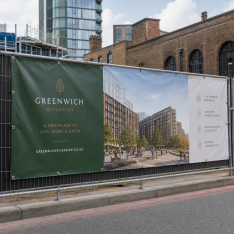
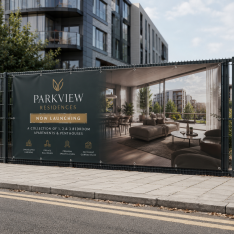
| Vinyl banner | 510gsm PVC | Large-format development or branch advertising |
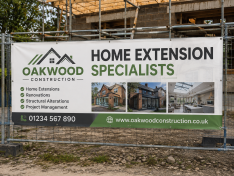
| Mesh banner | 350gsm mesh | Hoarding and scaffold-mounted property advertising |
The material column is the decision. Correx is a consumable for temporary property marketing measured in months; Foamex and banners are for installations measured in years or for areas far larger than a property board. Ordering the wrong one usually means paying three times the price for a sign that will come down in eight weeks anyway.
Fast Estate Agent Board Printing & UK Delivery
Boards are produced on five service levels, and the clock starts from artwork approval rather than order placement. For an agency, that distinction is the whole game — a property that comes to market on Tuesday should have a board on it by Thursday, not the following week.
| Service | Timing | When it makes sense |
|---|---|---|
| Standard | Within 5 working days from artwork approval | Planned fleet restocking |
| 72-hour | Three working days | Topping up before a busy listing week |
| 48-hour | Two working days | Running low mid-month |
| 24-hour | Printed and dispatched same working day | New instruction needing a board immediately |
| Same day | Collection, subject to daily capacity | Board needed on a property today |
The honest advice from this table is to use it rarely. Express uplifts run from 20% to 100%, and an agency that plans its board stock properly should be buying on standard at bulk rates almost every time. Keep express for the genuine emergency — a high-value instruction won on a Friday afternoon.
The best defence against express charges is holding stock. Boards do not expire, your branding does not change monthly, and buying twenty at £7.74 rather than five at £11.05 three times a year saves money twice over — on the unit rate and on the express uplifts you then never need.
Why Order Estate Agent Boards From Printed Today
- Published pricing. The full bulk ladder is on this page, so you can budget a fleet before you reach checkout.
- Genuine area-based bulk pricing. Mixed orders combine — boards, slips and variants all count toward one area total and one lower rate.
- 4mm Correx, stated plainly, with flute orientation set to your mounting arrangement.
- Any size at the same rates, including your existing house format if it is not 813 × 610 mm.
- Five production speeds, including 24-hour and same-day collection for new instructions that cannot wait.
- Artwork checked before print, with a proof to approve and a call if there is a problem.
- Fleet consistency. Send one master file and we produce every board, slip and branch variant to match.
- Support hours that match agency hours — phone to midnight on weekdays, live chat to 10pm.
Order Your Estate Agent Boards
Configure your size, orientation, print sides and quantity above and proceed to checkout. If you are setting up a full board fleet for the first time, or replacing an existing one across several branches, call first — a five-minute conversation about quantities usually saves more than the boards cost.
- Telephone: 0208 077 1994 — 8am to midnight weekdays, 11am to 7pm weekends
- Live chat: 8am to 10pm, straight through to the team handling your order
- Email: [email protected]
Estate and letting agencies ordering regularly should speak to our trade sales team or request a trade quote for account pricing and consolidated multi-branch ordering.
Prices on this page are calculated from our published square-foot rates on the standard service and exclude VAT and delivery. The live calculator is the source of truth for your exact configuration.